
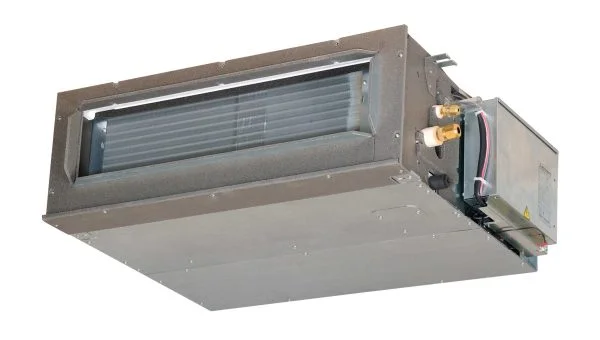
A concealed unit performs through the ductwork and terminals connected to it. We select airflow, external static pressure, acoustic targets and maintenance access together with cooling and heating capacity.

Technical reference
- High-static family: FDU — Up to 200 Pa for the relevant KXE6F group, subject to model, fan and setting conditions
- Medium-static family: FDUM — 10–100 Pa setting range in the KXE6F group; verify the duty point at required airflow
- Example capacity: 2.8 / 3.2 kW — FDUM28KXE6F cooling / heating at ISO-T1 conditions
- Example casing: 280 × 750 × 635 mm — FDUM28KXE6F; service and drainage space are additional
Static pressure belongs to a complete air path
Duct friction, bends, return grilles, filters and supply terminals create the resistance the fan must overcome. We calculate these losses at the required airflow. A higher pressure rating is not automatically a better choice: unnecessary fan pressure can increase noise and consumption. FDU, FDUM and slim FDUT serve different duty points.
Auto E.S.P. supports adjustment, not poor duct design
Automatic external-static-pressure control on compatible FDU and FDUM models helps the unit respond to the connected duct conditions. It cannot fix undersized ducts or unsuitable terminals. At commissioning, we measure total airflow and its distribution between rooms, then compare the settings with the design.
Give return air the same attention as supply air
A decorative slot diffuser is only the visible part of the system. Return-air free area, filter access and ceiling-void airtightness also matter. We check insulation continuity to reduce condensation risk and agree access to the fan and drain tray before the ceiling is closed.
A slim casing does not imply a long duct allowance
FDUT is evaluated for slim, low-static-pressure duct applications. Its shallow casing can help where ceiling depth is limited, but the duct resistance must remain within the model’s limits. If the airflow duty cannot be met, we revise the route, terminal layout or unit family.
Our selection checklist
- Calculate total pressure loss at design airflow
- Check return-air area and filter access
- Coordinate insulation and condensate drainage
- Measure airflow, balance branches and verify fan settings
Frequently asked questions
Will a 100 Pa unit always deliver the required air through a 100 Pa duct?
The required airflow, fan speed, adjustment range and manufacturer’s operating conditions must be checked together. Selection uses the duct system’s duty point.
Can the unit be sealed completely above the ceiling?
Filters, fans, electrical connections and drainage require maintenance access. The access arrangement belongs in the installation design.
Explore the complete system
Mitsubishi Heavy Industries VRF systems- Mitsubishi Heavy Micro KXZ
- Mitsubishi Heavy KXZ Lite
- Mitsubishi Heavy KXZ2
- Mitsubishi Heavy Cassette Indoor Units
- Mitsubishi Heavy Wall-mounted Indoor Units
- Mitsubishi Heavy Ceiling and Floor Indoor Units
Plan your system with SCA
Share your floor plan, operating hours and preferred installation locations. Our Istanbul-based team supports projects across the Marmara region, from site survey and equipment selection to installation, testing and commissioning.
We coordinate the refrigerant circuit, electrical supply, drainage, ventilation and controls as one project. Your proposal identifies the selected models, accessories and installation scope.
Discuss your project Call SCA