
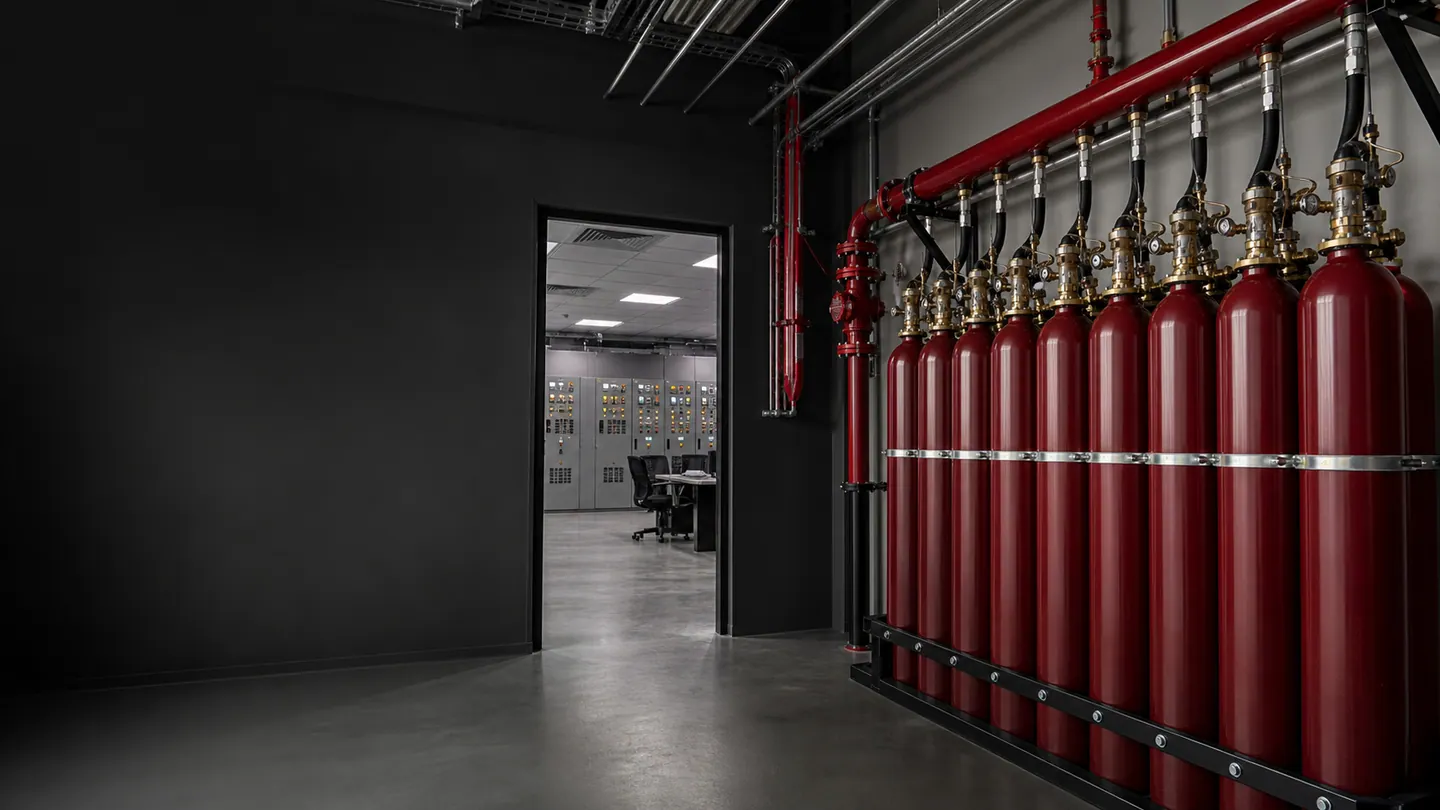
Inert-gas suppression reduces the oxygen level under the selected design conditions to interrupt combustion. Agent family, personnel access and enclosure behaviour must be assessed together. We evaluate IG-01, IG-100, IG-55 or IG-541 applications according to the project, coordinating cylinder space, distribution, pressure relief, room integrity and control interfaces.
Different IG families have different identities
Argon, nitrogen and approved gas mixtures are not one interchangeable product. The IG code identifies the agent family and the applicable calculation conditions. IG-541 is also distinct from a carbon-dioxide-only system. We specify the selected agent and complete system, comparing the available cylinder space, delivery and maintenance access with the protected hazard and the manufacturer’s requirements.
Personnel access requires its own assessment
Reducing oxygen is central to the suppression mechanism and makes occupancy and access conditions an explicit design issue. Warning, evacuation, activation and manual-control arrangements must follow the selected application. We do not describe an inert-gas installation as automatically safe wherever people may be present. The operating sequence is coordinated with the responsible teams and recorded in the handover.
Room integrity and pressure relief are separate
Keeping the required agent within the enclosure and managing discharge pressure are different tasks. A tight room may still require pressure-relief provisions, while a vent does not establish adequate retention. Vent area, route and room pressure limits are assessed through the selected design method and structural coordination. Cable penetrations and changes to room boundaries can affect the earlier integrity assessment.
Distribution and critical equipment
Hydraulic calculations must match the installed pipe routing, fittings and nozzles. For sensitive IT equipment, nozzle acoustics and discharge effects are evaluated against the actual equipment inventory where relevant. The label “quiet nozzle” alone does not establish suitability. Cylinder and nozzle access, testing interfaces and service reinstatement are planned with the building and operation teams.
Technical points we check
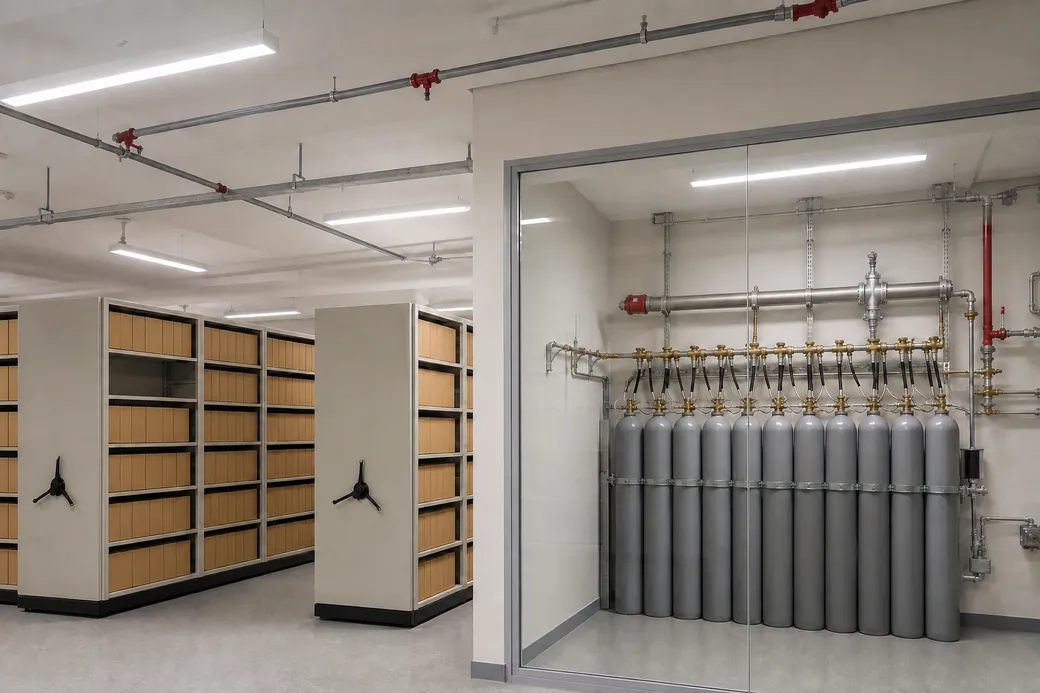
- Agent code, approved system identity and cylinder/service-space requirements.
- Personnel-access conditions and the complete warning/activation sequence.
- Enclosure integrity, pressure relief and structural limits assessed separately.
- Actual pipe/nozzle routing and relevant acoustic considerations for sensitive IT equipment.
From site survey to handover
We begin with the protected hazard, occupancy, building layout and available infrastructure. The design documents define the selected system, equipment limits, detection and control interfaces, installation responsibilities and acceptance checks. Tests are planned with the building team so that isolations, alarms and reinstatement are controlled. We provide the agreed drawings, equipment records and operating instructions, including the changes that require the protection strategy to be reviewed.
Frequently asked questions
Are IG-55 and IG-541 the same system?
They are different agent families. Agent identity, approved calculation conditions and compatible system components must be established for the chosen installation.
Does a tight enclosure eliminate pressure-relief requirements?
No. Agent retention and discharge pressure are different assessments. The pressure-relief requirement is determined for the selected system and the enclosure’s limits.
Related solutions
Let's plan your project
Share your plans, existing equipment information and operating priorities with SCA Engineering. Our Istanbul-based team supports surveys, mechanical design, installation and commissioning across the Marmara region. We will clarify the technical scope and prepare a proposal suited to your building.
Discuss your project with SCA Engineering · Explore our completed projects
