
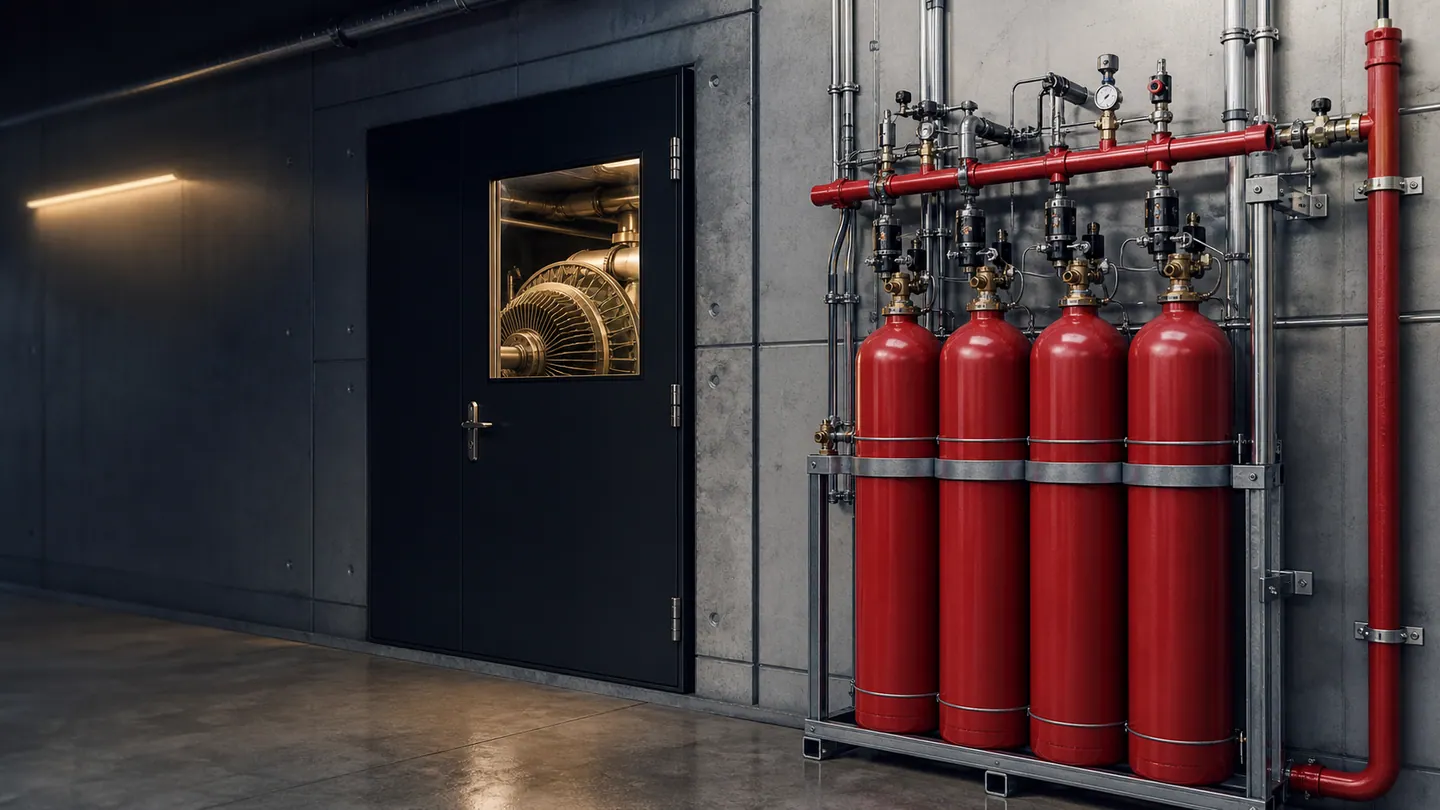
Carbon dioxide suppression can be evaluated for specific industrial hazards, with personnel exposure treated as a critical design issue. We assess total-flooding or local-application arrangements according to the protected equipment and accepted strategy. Detection, warnings, physical isolation, access and controlled return to service are developed alongside the agent and distribution design.
Residue-free does not mean breathable
Carbon dioxide can suppress fire without leaving a solid extinguishing residue, but that does not make the discharge atmosphere safe to breathe. Personnel access, evacuation, warnings and the restrictions of the selected application require explicit assessment. We avoid treating CO₂ as equivalent to every clean-agent installation. The design and operating procedures identify how people are protected before, during and after activation.
Local application and room protection
Local application targets specified equipment or surfaces; total flooding protects an enclosure under defined conditions. They have different protection boundaries and calculation requirements. We establish the actual hazard, equipment geometry and surrounding spaces before selecting the method. Changes to a machine or enclosure can affect the design even when the existing cylinders and pipes remain in place.
Isolation and distribution interfaces
A panel command is not necessarily a physical isolation of the agent supply. Maintenance access requires the appropriate isolation and status checks defined for the system. Manifolds, selector valves and nozzle networks must correspond to the protected hazards and approved calculation. A detection signal, a release command and confirmed discharge are separate states that should be understood in the control sequence.
Adjacent areas and reinstatement
The possibility of gas migrating into lower or connected spaces is evaluated with the enclosure and ventilation arrangement. After discharge, access depends on the relevant clearance and atmosphere-verification process, not a generic waiting time. We agree responsibilities for ventilation, assessment, inspection and reinstatement. The handover documents the protected boundaries and operating restrictions for the building and maintenance teams.
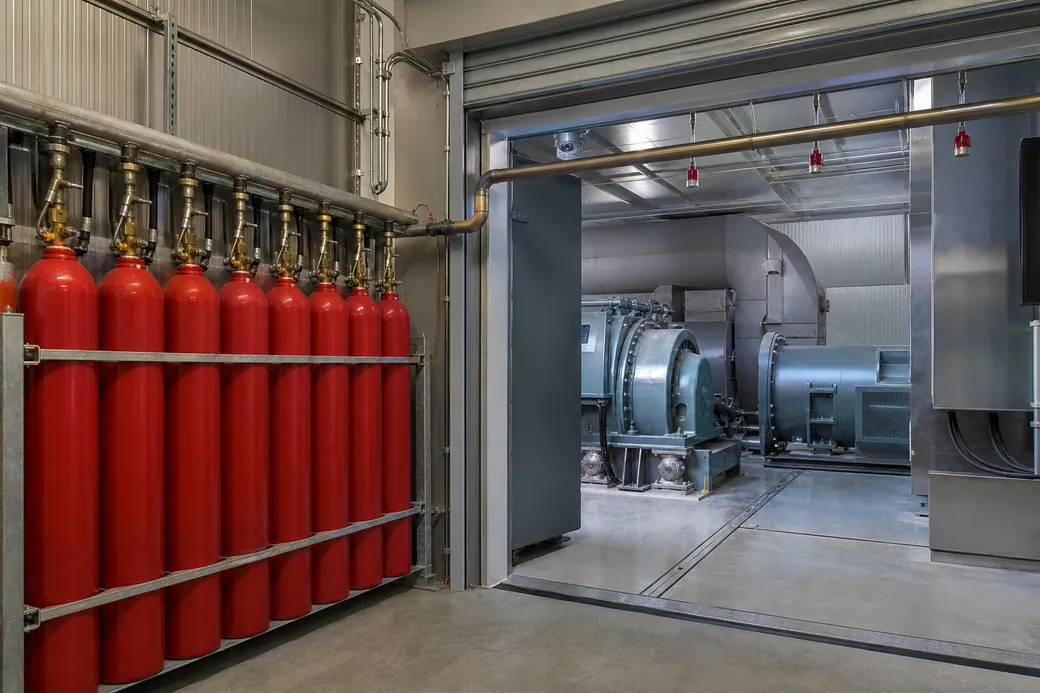
Technical points we check
- Protected industrial hazard, method and explicit personnel-exposure assessment.
- Warnings, evacuation, physical isolation and supervised status.
- Approved manifold, selector-valve and nozzle arrangement.
- Connected lower spaces, post-discharge access and controlled reinstatement.
From site survey to handover
We begin with the protected hazard, occupancy, building layout and available infrastructure. The design documents define the selected system, equipment limits, detection and control interfaces, installation responsibilities and acceptance checks. Tests are planned with the building team so that isolations, alarms and reinstatement are controlled. We provide the agreed drawings, equipment records and operating instructions, including the changes that require the protection strategy to be reviewed.
Frequently asked questions
Can CO₂ be installed wherever people work?
It should not be assumed suitable for every occupied area. The hazard, exposure, access arrangements and selected protection strategy require a specific assessment.
Is switching off the control panel enough for maintenance?
The required isolation is defined by the selected system and service procedure. A control-panel action must not be treated automatically as a physical isolation of the agent supply.
Related solutions
Let's plan your project
Share your plans, existing equipment information and operating priorities with SCA Engineering. Our Istanbul-based team supports surveys, mechanical design, installation and commissioning across the Marmara region. We will clarify the technical scope and prepare a proposal suited to your building.
Discuss your project with SCA Engineering · Explore our completed projects
