

A fire hose cabinet must be reachable, usable and supplied with the required water duty. We coordinate the cabinet type, hose arrangement, nozzle, pipe network and the actual route through the building. SCA Engineering assesses new installations and alterations with attention to hydraulic performance, access and documented testing.
Hose arrangements are not interchangeable
The EN 671 family distinguishes semi-rigid hose-reel and lay-flat hose arrangements. The selected cabinet, hose and nozzle must form a suitable combination for the project’s accepted requirements. Changing the hose or nozzle should include an equivalence and compatibility review; connection size alone does not establish the same performance. We record equipment identity and the intended operation in the delivered information.
Reach follows the building route
A circle drawn around the cabinet cannot represent every accessible route. Doors, corners, partitions and obstructions affect how the hose can be deployed to the intended areas. We compare the available hose route with the actual layout and coordinate the cabinet location with circulation. New partitions or changes to door access can alter the earlier coverage assessment and should be reviewed.
Flowing duty rather than static pressure
Pressure visible on a closed line does not prove the required performance at the nozzle when water flows. Pipe resistance, elevation and the agreed concurrent demand affect the supply. We assess the network and relevant operating measurements together. An existing cabinet should not be accepted solely because water appears at the nozzle or a pressure gauge shows a plausible reading.
Cabinet installation and test access
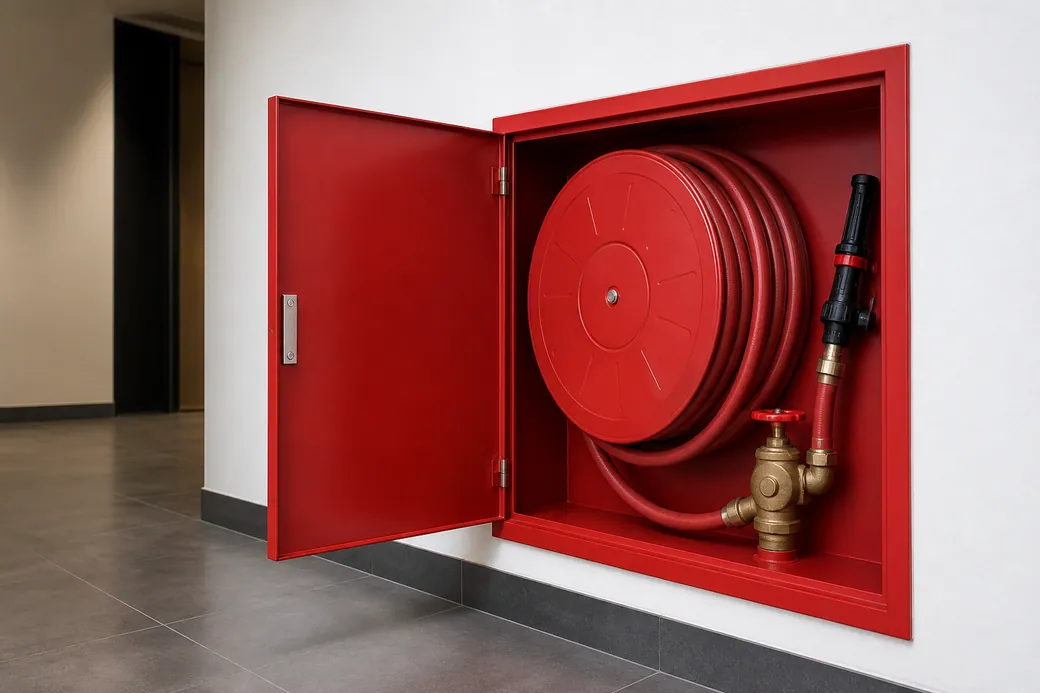
Recessed cabinets require an appropriate niche, wall arrangement and opening clearance. The door and surrounding finish should allow equipment access without obstructing operation. Isolation, maintenance access and test-water disposal are coordinated before installation. We document the agreed inspection and tests, then identify who restores the cabinet and any isolated section to normal service.
Technical points we check
- Cabinet, semi-rigid or lay-flat hose and nozzle compatibility.
- Deployment route through doors, corners and the actual partition layout.
- Required flowing duty, pipe losses and concurrent water demand.
- Niche, door clearance, test-water disposal and maintenance access.
From site survey to handover
We begin with the protected hazard, occupancy, building layout and available infrastructure. The design documents define the selected system, equipment limits, detection and control interfaces, installation responsibilities and acceptance checks. Tests are planned with the building team so that isolations, alarms and reinstatement are controlled. We provide the agreed drawings, equipment records and operating instructions, including the changes that require the protection strategy to be reviewed.
Frequently asked questions
Can cabinet coverage be checked with a radius on the plan?
A radius is only an initial indication. The actual hose route through doors, turns and obstructions must be considered for the intended deployment.
Does visible pressure prove a cabinet will perform?
Static pressure alone does not establish flowing nozzle performance. The relevant flow and pressure checks should be evaluated with the network and selected equipment requirements.
Related solutions
Let's plan your project
Share your plans, existing equipment information and operating priorities with SCA Engineering. Our Istanbul-based team supports surveys, mechanical design, installation and commissioning across the Marmara region. We will clarify the technical scope and prepare a proposal suited to your building.
Discuss your project with SCA Engineering · Explore our completed projects
